


How Multi-Car Carrier Loading Capacity Affects Per-Vehicle Cost of Packers and Movers


When several vehicles travel on the same carrier, the number of cars loaded onto the truck can influence the cost of packers and movers. Multi-car carriers allow transporters to distribute certain operating expenses across multiple vehicles, potentially reducing the average transportation cost per car. However, the savings depend on loading capacity, vehicle dimensions, route distance, and how efficiently the carrier is utilized.
Understanding these factors helps customers evaluate quotations and see why transporting one car individually may cost more per vehicle than moving several cars together.
Understanding Multi-Car Carrier Loading Capacity
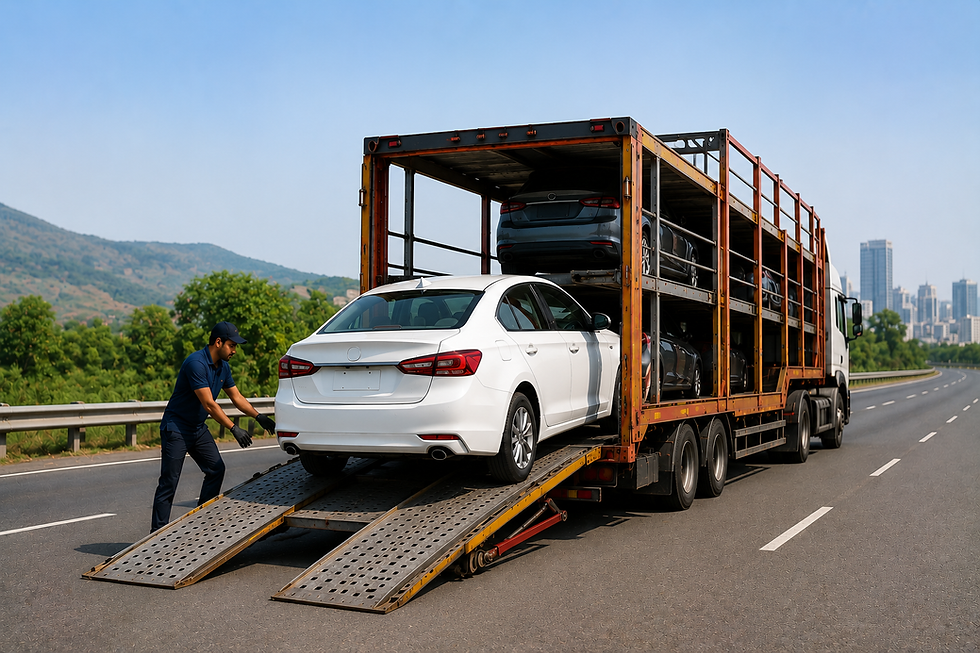
Multi-car carriers use specialized platforms to transport multiple vehicles in a single journey. Depending on their design, they may accommodate several hatchbacks, sedans, or SUVs.
However, maximum capacity does not always mean every available space can be used. Larger vehicles require additional clearance, while weight distribution, securement requirements, and safe loading arrangements can limit the number of cars transported.
For example, a carrier that accommodates eight compact cars might carry fewer vehicles when its load includes larger SUVs. This difference directly affects how many customers can share the trip's expenses.
How Loading Capacity Changes the Cost Per Vehicle
The primary financial advantage of a multi-car carrier is the distribution of shared operating expenses.
Operating expense | Impact of carrying more cars |
Fuel | Trip fuel expenses can be shared across more vehicles. |
Driver wages | Labor costs are distributed among customers. |
Tolls | Applicable route charges can be divided across the load. |
Trip management | Dispatch and coordination expenses can be shared. |
Consider a simplified example in which a carrier's total trip expense is ₹24,000.
Cars transported | Average trip expense per car |
4 | ₹6,000 |
6 | ₹4,000 |
8 | ₹3,000 |
These figures are illustrative and assume the total trip expense remains unchanged.
In practice, additional weight, handling requirements, and route conditions can increase expenses. Nevertheless, better utilization generally creates more opportunities to reduce average costs.
What Happens When a Carrier Is Partially Loaded?
An underutilized carrier can increase the average cost of transporting each vehicle. If a truck designed for eight cars departs with only four, fewer customers share its operating expenses.
Transporters may respond by adjusting quotations, waiting to consolidate additional bookings, or scheduling vehicles on a different departure. Each option has implications for delivery timelines and pricing.
For customers, this means that car transport cost may vary depending on carrier availability and booking demand, even when the pickup and delivery locations remain unchanged.
A partially loaded carrier does not automatically mean a customer will pay more. The final quotation also depends on the transporter's pricing policy, existing bookings, and commercial agreements.
Four Factors That Influence Carrier Utilization
1. Vehicle dimensions and weight
SUVs and larger vehicles can occupy more loading space than compact cars. Their weight may also affect the carrier's safe loading limits.
2. Route demand
Popular routes may attract enough bookings to fill a carrier quickly. Less frequently served routes may experience lower utilization or require longer consolidation periods.
3. Pickup and delivery locations
Vehicles collected from widely separated locations can require additional detours. These extra kilometres and handling requirements may reduce the financial benefit of carrying more cars.
4. Scheduling and return journeys
Transporters that coordinate outbound and return loads efficiently may reduce empty running. Poor scheduling can leave a carrier partially loaded on one leg, increasing overall operating expenses.
How Customers Can Compare Quotations
Before selecting a transporter, look beyond the advertised price and ask practical questions:
Does the quotation cover door-to-door pickup or terminal-to-terminal transportation?
Is the vehicle transported on a shared multi-car carrier or through a dedicated arrangement?
Are insurance, tolls, taxes, and handling charges included?
Could consolidation affect the expected pickup or delivery date?
Is the quoted price fixed, or can additional charges apply?
Compare quotations for the same route, service level, and delivery expectations. A slightly higher quote may provide greater scheduling certainty or include services excluded from a cheaper alternative.
Conclusion
Multi-car carrier loading capacity affects per-vehicle pricing by determining how efficiently transporters distribute shared journey expenses. Higher utilization can reduce average operating costs, while oversized vehicles, weak route demand, and partial loads may limit potential savings. To evaluate car transport cost, compare the complete service offering loading arrangement, and a written quotation rather than assuming that the carrier with the highest capacity will always provide the lowest price.



Comments